


 MarkTrade
set playlist as favorite - mapping or shortcut
Inviato Wed 25 Mar 26 @ 9:51 pm
 DJ VinylTouch
MarkTrade wrote :
set playlist as favorite - mapping or shortcut
add_favoritefolder
Inviato Wed 25 Mar 26 @ 10:02 pm
 GKAudiO DJ
I like to have the addition of dB indicator on the record vu meter , to be accurate level on tracks or mixtape , thx
Inviato Thu 26 Mar 26 @ 1:53 am
 jeromeip
BETTER "RELOCATE MISSING FILE" FEATURE
It could be based on the recent "AI footprint" of songs (a missing file is probably one with 1/ same extension 2/ same bitrate 3/ same footprint – because it can be renamed and possibly slightly modified by tags).
It could be based on the recent "AI footprint" of songs (a missing file is probably one with 1/ same extension 2/ same bitrate 3/ same footprint – because it can be renamed and possibly slightly modified by tags).
Inviato Thu 02 Apr 26 @ 7:31 am
jeromeip
ONLINE TO LOCAL PLAYLIST CONVERSION
Ability to convert an external playlist (e.g. Deezer, Tidal, Soundcloud playlist...) to a local one (with finding local file with similar name, AI footprint, etc.).
This could be completed with an editable ”match dictionnary” (just like in Soundiiz app).
Ability to convert an external playlist (e.g. Deezer, Tidal, Soundcloud playlist...) to a local one (with finding local file with similar name, AI footprint, etc.).
This could be completed with an editable ”match dictionnary” (just like in Soundiiz app).
Inviato Thu 02 Apr 26 @ 7:39 am
 brunoliv
AI Playlist Organization via Prompt (Inside VirtualDJ)
See an example mockup image below.
--------------------
I recently played at a birthday party where the host sent me a playlist via TIDAL with over 100 tracks.
The playlist had multiple mixed genres (Pop, Rock, Funk, EDM) and no organization at all.
During the set, this made it difficult to quickly find the right track for each moment.
To work around this, I had to:
Take the track list outside VirtualDJ (create a list, expor as txt), use ChatGPT to separate songs by genre, Keep that reference open, Manually search each track inside VirtualDJ
It worked, but it was slow and broke the flow during the performance.
My sugestion is to add a feature where VirtualDJ can organize a playlist using AI based on a simple text prompt.
Example:
"Separate tracks into Pop, Rock, Funk and EDM"
and them VirtualDJ's AI analyzes the playlist and automatically creates groups such as:
Pop
Rock
Funk
EDM
Others (for tracks that don’t fit well in those genres)
It would be nice if it Works with local playlists, folders, and streaming playlistsand supports different types of prompts:
Genre-based, Energy level, Danceability, If it was huge sucess in the 80's and etc
When typing a new prompt, VDJ ask if the previous organization should be replaced or not
This would Saves time during preparation and live sets, eliminates the need for external tools, Makes large and unorganized playlists easier to use in real time.
ANOTHER SUGESTION LINKED TO AI ORGANIZATION
It would be extremely useful if the result of this AI classification could be saved as a field/column inside the browser.
For example:
The user runs a prompt:
“Separate by energy level: High Energy, Low Energy, Romantic"
VirtualDJ would:
Create a new column (or field) in the browser with an AI icon (to indicate it was generated by AI), a label like: Energy Level
Each track would then have values such as:
High Energy
Low Energy
Romantic
With This feature we can reorgane playlists without losing the AI classification
Sorting by other columns (BPM, Artist, Duration, etc.) while still seeing how AI categorized each track
In practice I can sort by BPM or Artist and still see the AI-generated classification for quick decision-making during a live set
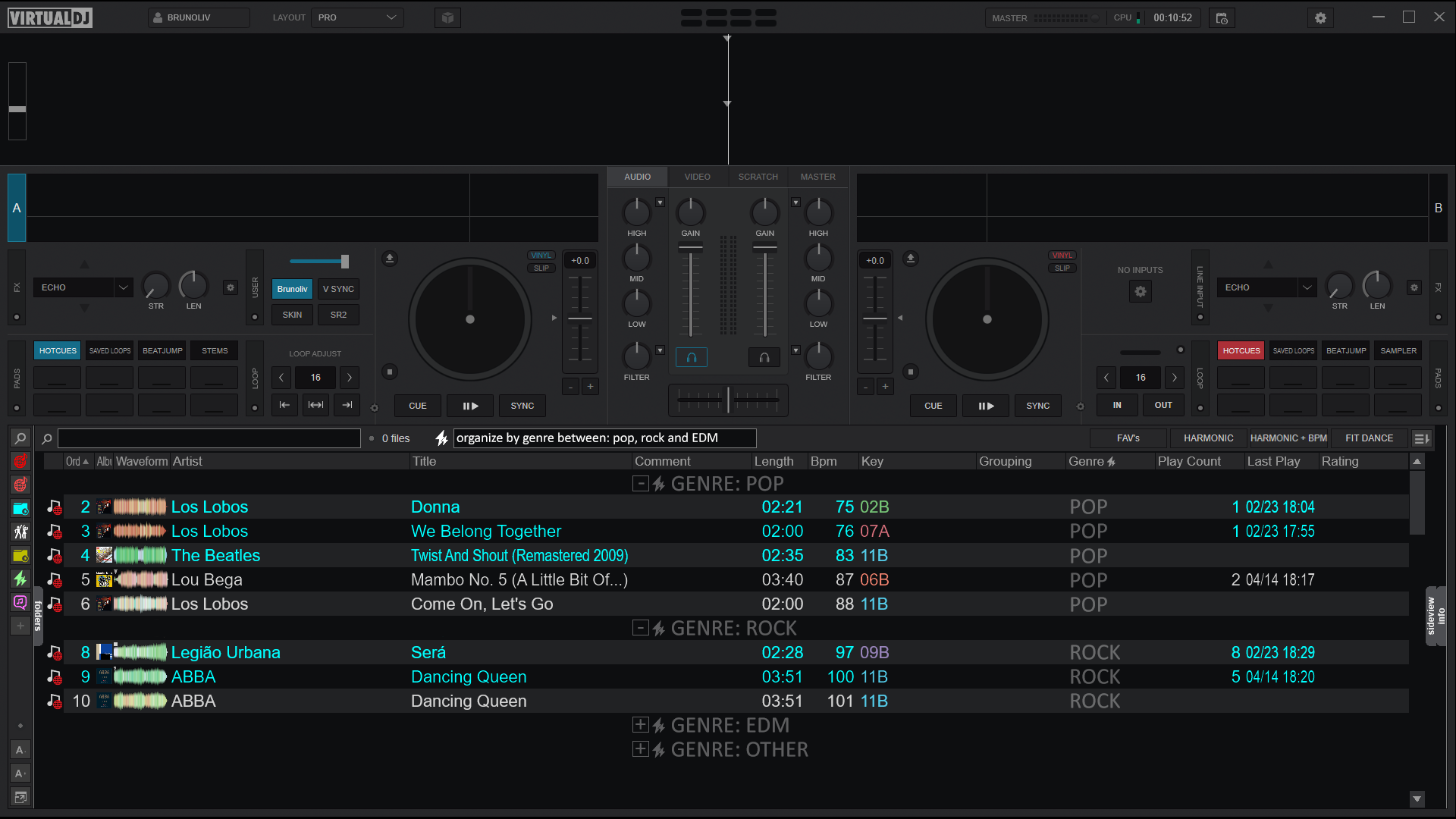
See an example mockup image below.
--------------------
I recently played at a birthday party where the host sent me a playlist via TIDAL with over 100 tracks.
The playlist had multiple mixed genres (Pop, Rock, Funk, EDM) and no organization at all.
During the set, this made it difficult to quickly find the right track for each moment.
To work around this, I had to:
Take the track list outside VirtualDJ (create a list, expor as txt), use ChatGPT to separate songs by genre, Keep that reference open, Manually search each track inside VirtualDJ
It worked, but it was slow and broke the flow during the performance.
My sugestion is to add a feature where VirtualDJ can organize a playlist using AI based on a simple text prompt.
Example:
"Separate tracks into Pop, Rock, Funk and EDM"
and them VirtualDJ's AI analyzes the playlist and automatically creates groups such as:
Pop
Rock
Funk
EDM
Others (for tracks that don’t fit well in those genres)
It would be nice if it Works with local playlists, folders, and streaming playlistsand supports different types of prompts:
Genre-based, Energy level, Danceability, If it was huge sucess in the 80's and etc
When typing a new prompt, VDJ ask if the previous organization should be replaced or not
This would Saves time during preparation and live sets, eliminates the need for external tools, Makes large and unorganized playlists easier to use in real time.
ANOTHER SUGESTION LINKED TO AI ORGANIZATION
It would be extremely useful if the result of this AI classification could be saved as a field/column inside the browser.
For example:
The user runs a prompt:
“Separate by energy level: High Energy, Low Energy, Romantic"
VirtualDJ would:
Create a new column (or field) in the browser with an AI icon (to indicate it was generated by AI), a label like: Energy Level
Each track would then have values such as:
High Energy
Low Energy
Romantic
With This feature we can reorgane playlists without losing the AI classification
Sorting by other columns (BPM, Artist, Duration, etc.) while still seeing how AI categorized each track
In practice I can sort by BPM or Artist and still see the AI-generated classification for quick decision-making during a live set
Inviato Sat 18 Apr 26 @ 4:02 am
 klausmogensen
brunoliv wrote :
AI Playlist Organization via Prompt (Inside VirtualDJ)
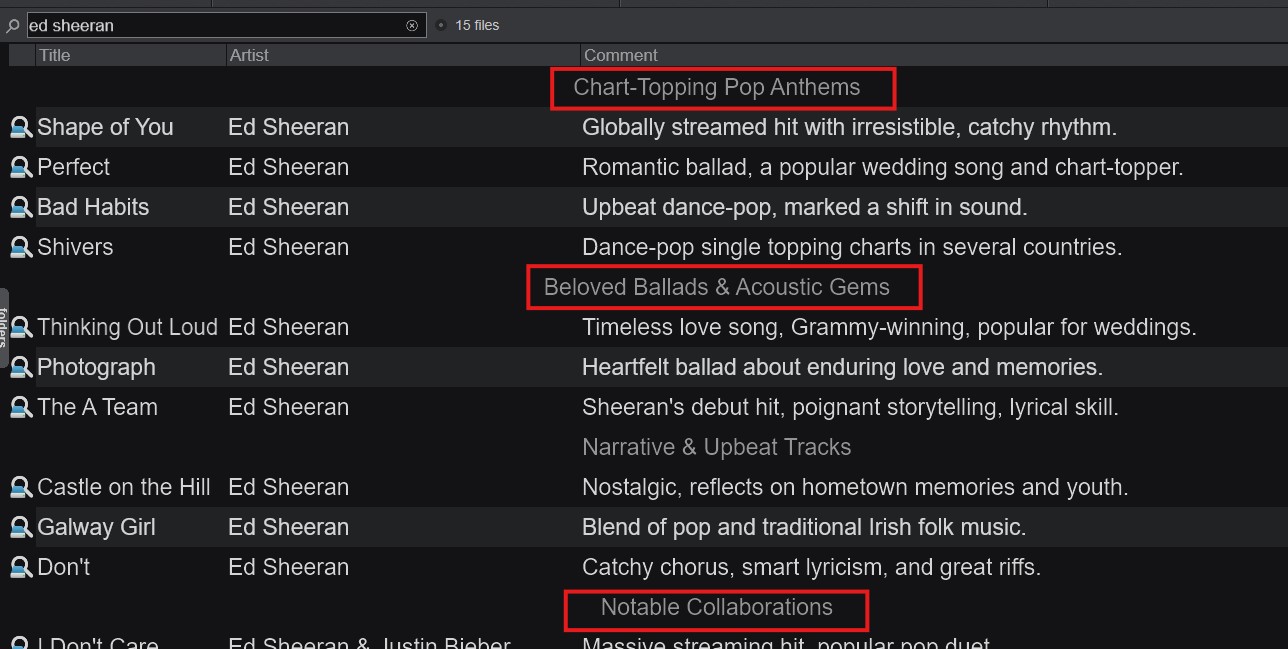
Doesn't it already kind of do that?
Inviato Sun 19 Apr 26 @ 3:39 pm
klausmogensen
Maybe an option to have the AI prompt as the default search?
Inviato Sun 19 Apr 26 @ 3:40 pm
 groovindj
I agree - rather than having it hidden away in the ideas folder, maybe have an AI button next to the search options.
Inviato Sun 19 Apr 26 @ 3:58 pm
brunoliv
klausmogensen wrote :
Doesn't it already kind of do that?
Doesn't it already kind of do that?
I think there was a misunderstanding.
The current AI feature in VirtualDJ is focused on generating playlist suggestions (i.e., creating a new list of tracks based on a prompt).
What I’m suggesting is different:
The idea is to use a prompt to organize an already existing playlist, not generate a new one.
For example:
A playlist I already have (local folder, VirtualDJ playlist, or streaming like TIDAL)
With 100+ tracks
Then I type:
> “Separate tracks into Pop, Rock, Funk and EDM”
And VirtualDJ would:
Analyze those existing tracks
Group them inside the same playlist (or view)
Optionally tag them (e.g., with an AI-generated field/column)
So instead of creating a new playlist suggestion, it reorganizes what I already have
The image shows a similar view of existing ai feature, but the usability is different
Inviato Mon 20 Apr 26 @ 6:26 am
groovindj
Assuming the tracks have an accurate genre tag, why not just sort them by the genre column in the browser?
If they don't have genre assigned, they can be selected en masse and tagged from discogs via the tag editor (which is what I do when using playlists from streaming services).
The first is a single click, the second is select and two clicks. What's the benefit of typing in a command for AI to do it?
If they don't have genre assigned, they can be selected en masse and tagged from discogs via the tag editor (which is what I do when using playlists from streaming services).
The first is a single click, the second is select and two clicks. What's the benefit of typing in a command for AI to do it?
Inviato Mon 20 Apr 26 @ 9:23 am
 kradcliffe
Agreed, tag by genre then you can use filter folders. That's what I do and it works great.
Inviato Mon 20 Apr 26 @ 9:38 am
brunoliv
groovindj wrote :
Assuming the tracks have an accurate genre tag, why not just sort them by the genre column in the browser?
If they don't have genre assigned, they can be selected en masse and tagged from discogs via the tag editor (which is what I do when using playlists from streaming services).
The first is a single click, the second is select and two clicks. What's the benefit of typing in a command for AI to do it?
If they don't have genre assigned, they can be selected en masse and tagged from discogs via the tag editor (which is what I do when using playlists from streaming services).
The first is a single click, the second is select and two clicks. What's the benefit of typing in a command for AI to do it?
I get your point, and for basic cases I agree, if the genre tag is correct, sorting by the genre column works fine.
But the idea here goes beyond just genre sorting.
A few limitations with the current approach:
- Streaming playlists (like TIDAL) often come with missing or inconsistent metadata
- Genre tags are usually too broad or inaccurate
- Using Discogs helps, but:
- It’s still a manual step
- Not always reliable for every track
- Doesn’t cover more subjective classifications
What AI would add (beyond genre)
The main advantage is flexibility. You’re not limited to existing tags.
Examples:
"Separate tracks by energy level: High / Medium / Low"
"More danceable vs less danceable tracks"
"Warm-up vs peak time vs closing tracks"
"Songs that feel nostalgic vs modern"
"Tracks similar to EDM vs more pop-oriented"
"Songs that work early in the night vs late night"
These are things you can’t reliably get from standard tags.
In real scenarios (like the one I described), you receive a playlist that is:
Large
Mixed
Not prepared for DJ use
The goal isn’t just organizing by metadata, but quickly adapting that playlist to a usable DJ structure, without external tools or manual tagging.
Current workflow: relies on existing tags (when they exist and are correct)
Suggested feature: creates new, contextual classification on demand
So the benefit isn’t replacing genre sorting, it’s enabling dynamic, custom organization based on how the DJ actually thinks during a set.
Inviato Mon 20 Apr 26 @ 10:25 pm
 locoDog
Right clicked folder properties;
Could the path show the path that will work with goto_folder, it's fine for most cases but with the defaults there is a complication.
ask the dj folder properties returns "askthedj:" and goto_folder "askthedj:" returns true when there,
but to actually get there needs
goto_folder "askthedj://" which doesn't return true when there.
just the :// rule is hard to remember because I don't write it often. It's always a site lookup or rummaging round in custom buttons to relearn it.
minor QoL thing, could there be a copy to clipboard for the path? they can get a bit long if you have some folder navigating script on the go.
Possibly in the tag editor too, if adding a button in tag editor maybe a second button for open in explorer.
Could the path show the path that will work with goto_folder, it's fine for most cases but with the defaults there is a complication.
ask the dj folder properties returns "askthedj:" and goto_folder "askthedj:" returns true when there,
but to actually get there needs
goto_folder "askthedj://" which doesn't return true when there.
just the :// rule is hard to remember because I don't write it often. It's always a site lookup or rummaging round in custom buttons to relearn it.
minor QoL thing, could there be a copy to clipboard for the path? they can get a bit long if you have some folder navigating script on the go.
Possibly in the tag editor too, if adding a button in tag editor maybe a second button for open in explorer.
Inviato Tue 21 Apr 26 @ 12:55 am
groovindj
brunoliv wrote :
These are things you can’t reliably get from standard tags
What makes you think these can be obtained reliably from AI?
How can you be certain the AI will "think like a DJ"?
Yes using Discogs is a manual step, but so is typing in a line of text for the AI.
Discogs not always reliable - why would you think AI will be more reliable?
I'm not dismissing the concept, just questioning whether it would be as smart as you're hoping. It's been proven regularly that AI gets confused and even invents things.
Inviato Tue 21 Apr 26 @ 8:12 am
brunoliv
groovindj wrote :
What makes you think these can be obtained reliably from AI?
How can you be certain the AI will "think like a DJ"?
Yes using Discogs is a manual step, but so is typing in a line of text for the AI.
Discogs not always reliable - why would you think AI will be more reliable?
I'm not dismissing the concept, just questioning whether it would be as smart as you're hoping. It's been proven regularly that AI gets confused and even invents things.
brunoliv wrote :
These are things you can’t reliably get from standard tags
What makes you think these can be obtained reliably from AI?
How can you be certain the AI will "think like a DJ"?
Yes using Discogs is a manual step, but so is typing in a line of text for the AI.
Discogs not always reliable - why would you think AI will be more reliable?
I'm not dismissing the concept, just questioning whether it would be as smart as you're hoping. It's been proven regularly that AI gets confused and even invents things.
I get your concerns, and honestly I agree with part of it, AI doesn’t need to be perfect, and I’m not expecting it to be.
What I’m trying to suggest is more about speed and flexibility, especially in real situations.
For example, the case I mentioned: I received a playlist with 100+ tracks, all mixed, no organization.
In that moment, I didn’t need perfect metadata, I needed a quick way to understand and navigate that playlist.
I ended up exporting the list, using ChatGPT to organize it, and then going back into VirtualDJ to search track by track. It worked, but it completely broke the flow.
What I would’ve wanted was something inside VirtualDJ that could instantly give me different ways to look at the same playlist, depending on what I need.
Not just genre (that part is already solved), but things like:
- Which tracks feel like warm-up vs peak time vs closing
- Which ones are more aggressive vs more chill
- Tracks that work early in the night vs later
- Songs with strong drops vs smoother ones
- More commercial vs more underground
- Background vibe vs main dancefloor
A clear example:
A track like "The Weeknd - Blinding Lights" can appear in multiple playlists on Spotify with completely different purposes:
Workout / Gym (due to its steady energy)
Party / Dance (because it’s danceable)
80s Vibes / Nostalgia (due to its retro sound)
Road Trip (because it’s engaging and easy to listen to)
Pop Hits (because of its commercial success)
Let’s say Blinding Lights is already in my playlist and the client asks me to make 30 minutes of music that will make him feel like he's in the 80s.
I type:
"80’s synth style"
The AI classifies it under something like: Retro / Synthwave / 80s Style
At another party, the client asks me to play pop songs that were hits in the 2020's.
Then I run another prompt:
"Successful pop songs from the 2020s"
The same track is now classified as: Modern Pop Hit / 2020s Hits
So the same track gets different classifications depending on context, without changing the original metadata just adding a new layer of interpretation based on what I need at that moment.
In other words, the same track fits into different contexts, which isn’t well represented by a single static tag.
These aren’t things you reliably get from tags or Discogs. They’re more about how DJs interpret music in context.
And yeah, typing a prompt is also manual, but it’s a single action that can reorganize everything instantly, instead of preparing metadata beforehand.
About reliability
I don’t think AI needs to be 100% correct here.
If it gets most of it right, that’s already useful. You can quickly scan and adjust a few tracks if needed.
So the idea isn’t to replace genre sorting or tagging tools.
It’s to have a fast, flexible layer on top, especially when you’re dealing with large playlists and little prep time.
Even more useful would be being able to run different prompts on the same playlist and quickly switch perspectives. like organizing once by “energy”, then by “moment of the night”, without losing the previous classification.
Inviato Fri 24 Apr 26 @ 7:55 pm
locoDog
Still unlikely, AI for individuals is mostly free, in a program it's an on going cost for the devs.
Inviato Fri 24 Apr 26 @ 8:01 pm
DJ VinylTouch
@locodog I think people are missing this part - it's all fun to have AI features in the software, but any feature that is being offloaded to a model somewhere else to do the job is a cost to the devs, even if they are hosting it themselves.
That's why it's important to determine if AI is really necessary for the job - a sledge hammer can drive a nail, but if the regular hammer can do the job, why not use it?.
At the end of the day, it's up to the devs - but Pro Infinity licence holders should be aware of how blessed they are to have these AI based features and not be paying more.
That's why it's important to determine if AI is really necessary for the job - a sledge hammer can drive a nail, but if the regular hammer can do the job, why not use it?.
At the end of the day, it's up to the devs - but Pro Infinity licence holders should be aware of how blessed they are to have these AI based features and not be paying more.
Inviato Fri 24 Apr 26 @ 9:50 pm
brunoliv
DJ VinylTouch wrote :
@locodog I think people are missing this part - it's all fun to have AI features in the software, but any feature that is being offloaded to a model somewhere else to do the job is a cost to the devs, even if they are hosting it themselves.
That's why it's important to determine if AI is really necessary for the job - a sledge hammer can drive a nail, but if the regular hammer can do the job, why not use it?.
At the end of the day, it's up to the devs - but Pro Infinity licence holders should be aware of how blessed they are to have these AI based features and not be paying more.
That's why it's important to determine if AI is really necessary for the job - a sledge hammer can drive a nail, but if the regular hammer can do the job, why not use it?.
At the end of the day, it's up to the devs - but Pro Infinity licence holders should be aware of how blessed they are to have these AI based features and not be paying more.
That’s a fair point, and I agree, AI features do have a cost, especially if everything is processed on the developer’s side.
I’m not suggesting this should necessarily be a “free for all” feature handled entirely by VirtualDJ’s infrastructure.
There are a couple of ways this could be implemented without putting all the cost on the devs:
1) User-provided API
Allow users to connect their own API from services they already pay for (like OpenAI, Google, etc).
VirtualDJ would:
Export the playlist data (track names, metadata, etc.)
Send it to the user’s configured API
Receive the structured result
Organize it inside the browser
In this case the cost is handled by the user
VirtualDJ just acts as the bridge/interface
2) Built-in AI (Paid Feature)
VirtualDJ could also offer their own integrated AI as an optional paid feature:
Monthly subscription for AI tools
Similar to how other platforms handle AI features
This creates a recurring revenue stream for the devs
A scalable way to support the infrastructure
The goal isn’t to force AI where it’s not needed.
For simple cases, Genre column, Filter folders, Tags already solve the problem.
But for more contextual and dynamic organization, AI opens possibilities that traditional tools don’t cover well.
So instead of replacing existing tools, this would be optional, flexible and scalable depending on how it’s implemented
This way, the feature can exist without becoming a burden on the developers, while still giving power users access to more advanced workflows.
Inviato Sun 26 Apr 26 @ 8:59 am
DJ VinylTouch
In this particular case, both are possible options and can coexist for ultimate flexibility (I personally would want it with the first option wherever possible, similar to the streaming and cloud subscription services already being offered in that way).
But it is key to remember the sequence starts with choosing the right tool for the job. A lot of the things specified can be achieved through proper folder organization, filter folder creation and referencing external databases for knowledge if necessary - a general purpose model might do a lot of this too because that is knowledge it might not have been trained on and still get it wrong (e.g. what is an "early night" song exactly? That can change depending on the crowd and theme of the night).
You might even be able to do it now, with some effort using an external tool you could write yourself (database.xml and vdjfolder xml format is fully readable, and I did it in the past to generate playlists back when it was still m3u based).
But it is key to remember the sequence starts with choosing the right tool for the job. A lot of the things specified can be achieved through proper folder organization, filter folder creation and referencing external databases for knowledge if necessary - a general purpose model might do a lot of this too because that is knowledge it might not have been trained on and still get it wrong (e.g. what is an "early night" song exactly? That can change depending on the crowd and theme of the night).
You might even be able to do it now, with some effort using an external tool you could write yourself (database.xml and vdjfolder xml format is fully readable, and I did it in the past to generate playlists back when it was still m3u based).
Inviato Sun 26 Apr 26 @ 2:02 pm
